Afrikaans
 Albanian
 Amharic
 Armenian
 Azerbaijani
 Greek
Greek Basque
 Chinese (Simplified)
 Chinese (Traditional)
 Belarusian
 Bengali
 Bosnian
 Bulgarian
 Catalan
 Cebuano
 Chichewa
 Corsican
 Croatian
 Czech
Czech Danish
 Dutch
Dutch Esperanto
 Estonian
 Filipino
 Finnish
 Frisian
 Galician
 Georgian
 Gujarati
 Haitian Creole
 Hausa
Hausa Hawaiian
 Hebrew
 Hmong
Hmong Hungarian
 Icelandic
 Igbo
Igbo Indonesian
 Irish
Irish Javanese
 Kannada
 Kazakh
 Khmer
Khmer Kurdish (Kurmanji)
 Kyrgyz
 Lao
Lao Latin
Latin Latvian
 Lithuanian
 Luxembourgish
 Macedonian
 Malagasy
 Malay
Malay Malayalam
 Maltese
 Maori
Maori Marathi
 Mongolian
 Myanmar (Burmese)
 Nepali
 Norwegian
 Pashto
 Persian
 Punjabi
 Samoan
 Scottish Gaelic
 Serbian
 Sesotho
 Shona
Shona Sindhi
 Sinhala
 Slovak
 Slovenian
 Somali
 Sudanese
 Swahili
 Swedish
 Tajik
Tajik Tamil
Tamil Telugu
 Turkish
 Ukrainian
 Urdu
Urdu Uzbek
Uzbek Vietnamese
 Welsh
Welsh Xhosa
Xhosa Yiddish
 Yoruba
 Zulu
Zulu
Why Are Multi-Span Glass Greenhouses More Expensive Than PC Sheet Greenhouses?
In the selection of protected agricultural greenhouses, the cost difference between multi-span glass greenhouses and multi-span PC (polycarbonate) sheet greenhouses has always been a core concern for growers. Data shows that for the same area, the total cost of glass greenhouses is usually 10% to 30% higher than that of PC sheet greenhouses. This gap is not caused by a single link, but stems from the difference in the properties of covering materials, which in turn drives up costs throughout the entire chain from basic materials to long-term maintenance. The specific reasons can be analyzed from four key dimensions.
1. Core Root Cause: Cost Gap of Covering Materials Themselves
The covering material of the greenhouse is the starting point of the cost difference. Glass and PC sheets (polycarbonate sheets) have completely different raw material properties and production processes, which directly determine the gap in their basic unit prices.
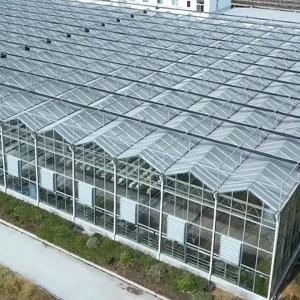
Ultra-white tempered glass, commonly used in multi-span glass greenhouses, relies on mineral raw materials such as high-purity quartz sand and soda ash for production. It undergoes multiple complex processes including high-temperature melting, precise forming, physical tempering, and anti-fog coating. These processes not only consume high energy but also have extremely high requirements for the precision of production equipment, resulting in a procurement cost per square meter that can be 2 to 3 times that of PC sheets. In contrast, PC sheets are synthetic chemical materials, with polycarbonate resin as the core raw material. They can be produced through an extrusion molding process and only require a UV anti-aging coating on the surface to meet the operational needs of greenhouses. The production process is simple, production capacity is stable, and both raw material and processing costs are significantly lower.
2. Structural Adaptation: Weight Drives Frame Costs to Double
The weight difference of covering materials directly leads to the upgrade of the design and material selection of the greenhouse's main frame, which is a key link that widens the cost gap. The commonly used 5mm tempered glass has a weight per unit area of about 12.5kg, which is more than ten times that of 8mm thick PC sheets (approximately 1.2kg/㎡). This significant weight load places higher requirements on the load-bearing capacity, wind resistance, and snow resistance of the frame, thereby increasing structural costs.
To support the weight of glass and cope with extreme weather, the main frame of multi-span glass greenhouses must use high-strength materials: trusses usually adopt hot-dip galvanized square tubes of 70×50×2.5mm, while ridge beams and purlins mostly use corrosion-resistant aluminum alloy materials, and additional reinforcing ribs are required in some areas. For multi-span PC sheet greenhouses, due to their light load, the frame can use thinner hot-dip galvanized steel tubes (such as 50×30×2.0mm) without additional reinforcing structures. The cost of the frame alone is about 40% lower than that of glass greenhouses.
3. Installation and Construction: Cumulative Costs in Labor and Auxiliary Materials
The complexity and safety requirements of the installation process further widen the cost gap between the two. The "heavy" and "fragile" characteristics of glass make the installation process have much higher requirements for labor, equipment, and auxiliary materials than PC sheets.
Glass installation requires a professional construction team. For high-altitude operations, hoisting equipment is needed to assist in transportation. Each piece of glass must be accurately aligned and fixed with special sealants and pressing strips to prevent water leakage and damage. The labor cost per square meter for installation can be more than 1.5 times that of PC sheets. At the same time, to avoid breakage caused by uneven stress on the glass edges, customized rubber gaskets, aluminum alloy pressing strips, and other auxiliary materials are required, which further increases the cost of auxiliary materials. In contrast, PC sheets are light in weight and flexible, allowing manual transportation and installation. During splicing, only simple sealing strips and self-tapping screws are needed for fixation, resulting in high installation efficiency and significantly lower labor and auxiliary material costs.
4. Long-Term Maintenance: Hidden Costs in Damage Repair and Daily Care
Although the service life of glass greenhouses (20-30 years) is much longer than that of PC sheet greenhouses (5-10 years), the difference in maintenance costs during long-term use is still a non-negligible cost factor.
Once glass is damaged, it must be replaced entirely. Not only is the procurement cost of new glass high, but the replacement also requires professional personnel to operate to avoid secondary damage to surrounding glass and frames. A single repair can cost several hundred yuan. Meanwhile, glass surfaces are prone to dust accumulation, which affects light transmittance, requiring 2 to 3 professional cleanings per year, resulting in continuous maintenance costs. For PC sheets, local damage can be repaired by directly cutting sheets of corresponding sizes, with a single repair cost of only a few dozen yuan. Their surface UV coating has anti-fouling properties, slowing down dust accumulation, and only one cleaning per year is sufficient to meet the needs, resulting in much lower long-term maintenance costs than glass greenhouses.
Conclusion: Cost-Effectiveness Choice Behind the Price Difference
The high cost of multi-span glass greenhouses is essentially a comprehensive reflection of "high-performance materials + high-strength structures + high-standard construction + long-term maintenance guarantees". They are suitable for large-scale planting projects that pursue long-term stable production and have high requirements for light transmittance (glass: 85%-90%, PC sheets: 60%-80%). PC sheet greenhouses, on the other hand, have the advantages of "economic practicality + convenient installation + low short-term maintenance costs", making them more suitable for scenarios with limited budgets and flexible planting cycles. The cost difference between the two is actually a cost allocation difference driven by different needs, and a comprehensive consideration of actual planting requirements is necessary when making a selection.
Related News